
FDA LISTING INC: EXPERIENCED ADVISORS FOR FULL-SERVICE FDA REGISTRATION & COMPLIANCE
+1 212 444 8202


U.S. FDA Registration
& Labeling Compliance Assistance
FDA eCTD Submission
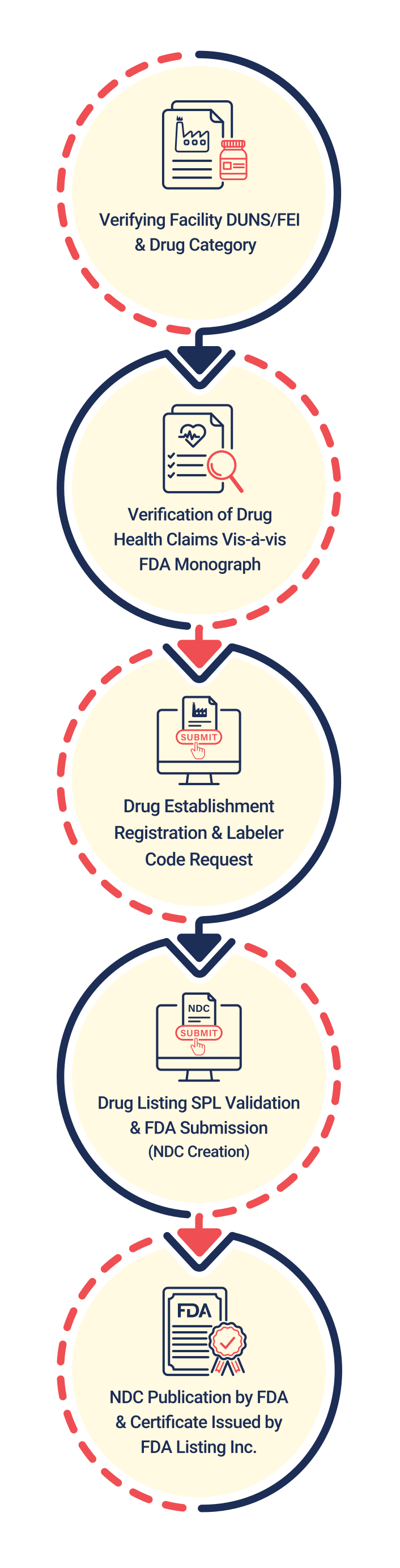
Click the button below to see the service steps in an easy-to-follow graphic format.

FDA eCTD Submission, Validation & Publishing
FDA Listing Inc. provides eCTD publishing, validation, and electronic submission support for companies submitting drug and biologic regulatory information to the FDA. Services are tailored to the application type, submission purpose, source-document readiness, existing eCTD history, and applicable FDA technical requirements.
Who Needs an eCTD Submission?
FDA uses the electronic Common Technical Document (eCTD) as the standard electronic format for many drug and biologic regulatory submissions to the Center for Drug Evaluation and Research (CDER) and Center for Biologics Evaluation and Research (CBER).
FDA requires eCTD for most commercial drug and biologic regulatory submissions, including New Drug Applications (NDAs), Abbreviated New Drug Applications (ANDAs), Biologics License Applications (BLAs), commercial Investigational New Drug Applications (INDs), and most master-file submissions, unless an exemption or waiver applies. Requirements may differ for certain noncommercial applications, Type III Drug Master Files, and other exempt submission types.
eCTD is also used for post-submission activities, including amendments, supplements, annual reports, responses to FDA information requests, and other lifecycle submissions. A properly structured eCTD sequence enables FDA to receive, process, navigate, and review regulatory information efficiently.
What Is an FDA eCTD Submission?
An eCTD submission is an electronic regulatory dossier based on the International Council for Harmonization (ICH) Common Technical Document structure and applicable FDA regional requirements. The submission includes electronic documents, metadata, and an XML backbone that lets FDA reviewers navigate the submission and understand its relationship to previous sequences.
The eCTD is organized into five modules:
1. Module 1 ………………….FDA regional and administrative information
2. Module 2 ………………….CTD summaries and overviews
3. Module 3 ………………….Quality and Chemistry, Manufacturing, and Controls (CMC)
4. Module 4 ………………….Nonclinical study reports
4. Module 5…………………..Clinical study reports
Not every submission requires content in every module. The application type and submission purpose determine the required documents, document placement, metadata, and lifecycle operations.
eCTD publishing involves more than assembling PDF files. Documents must be appropriately prepared, placed, linked, assigned metadata and leaf titles, and incorporated into the applicable lifecycle structure in accordance with FDA eCTD specifications.
eCTD Requirements and Submission Process
The application type, submission type, FDA center, and sequence purpose determine the applicable content and technical requirements. Before publishing, source documents should be reviewed for completeness, final status, correct placement, searchable text, bookmarks, hyperlinks, and consistency with the regulatory submission.
An FDA eCTD submission may include:
- FDA forms and administrative documents, as applicable
- Cover letter and submission description
- Application-specific documentation for an IND, NDA, ANDA, BLA, DMF, or other regulatory file
- Quality, CMC, and manufacturing documentation, where applicable
- Nonclinical and clinical information, where applicable
- Labeling, prescribing information, carton and container labeling, and related materials, where applicable
- Amendments, supplements, annual reports, responses to FDA requests, and other lifecycle documents
- Appropriate document placement, leaf titles, file naming, metadata, hyperlinks, bookmarks, and lifecycle operations
Companies generally transmit FDA electronic regulatory submissions through the FDA Electronic Submissions Gateway (ESG). eCTD sequences should be prepared using the applicable FDA-supported eCTD specifications and technically validated before transmission.
The typical eCTD submission process includes:
- Submission Assessment — Confirm the application type, submission purpose, FDA center, existing sequence history, and applicable eCTD requirements.
- Document and Content Review — Review available source documents, forms, labeling, and other submission materials for completeness and organization.
- Document Preparation — Prepare final electronic documents with searchable text, appropriate formatting, bookmarks, hyperlinks, and navigation, as applicable.
- eCTD Publishing — Place documents in the appropriate eCTD modules and sections, assign metadata and leaf titles, apply lifecycle operations, and generate the XML backbone.
- Technical Validation — Validate the eCTD package against applicable FDA technical specifications and address identified errors and warnings.
- ESG Transmission — Transmit the validated eCTD sequence through the FDA Electronic Submissions Gateway and monitor applicable electronic acknowledgments.
- Lifecycle Management — Maintain sequence history and prepare future amendments, supplements, reports, and FDA correspondence using the appropriate eCTD lifecycle structure.
Preparation time depends on the application type, number and condition of source documents, publishing complexity, existing eCTD history, and availability of final documents. Each eCTD package should be reviewed and validated before transmission. Successful ESG transmission does not mean that FDA has accepted, filed, or approved the underlying regulatory submission.
Important eCTD Compliance Notes
eCTD is a submission format, not an approval pathway. eCTD provides the structure for organizing and transmitting regulatory information to the FDA. It does not replace the scientific, clinical, quality, safety, or other substantive requirements applicable to the underlying application.
Application and sequence history matter. Each eCTD sequence is associated with a specific regulatory application and its submission history. Incorrect sequence numbering, document placement, lifecycle operations, or metadata can result in technical issues and may affect FDA processing or review.
Source documents should be final and submission-ready. Documents should be complete, legible, searchable, and internally consistent before publishing. Material changes after publishing may require updates and revalidation.
Validation does not guarantee FDA acceptance or approval. Technical validation helps identify issues against applicable specifications before transmission. FDA may still identify technical or substantive issues, request additional information, or take other action after receiving the submission.
What Happens After an eCTD Submission?
After transmission through the FDA Electronic Submissions Gateway, the sender should monitor the applicable electronic acknowledgments. Depending on the submission type and FDA center, acknowledgments may confirm successful upload to ESG, transmission to the appropriate FDA Center, and a Center-level response. These acknowledgments confirm electronic processing steps; they do not mean that FDA has accepted, filed, cleared, licensed, or approved the underlying application.
The subsequent FDA review process depends on the application and submission purpose. FDA may accept the submission for filing or review, issue information requests, request an amendment, or take other action under the applicable regulatory process.
Following an original application or initial sequence, companies generally need to maintain the electronic lifecycle of the regulatory file. Subsequent submissions may include amendments, supplements, annual reports, safety reports, responses to FDA correspondence, labeling updates, manufacturing changes, and other application-specific regulatory submissions.
How Can FDA Listing Inc. Assist?
FDA Listing Inc. provides practical FDA eCTD submission support for drug and biologic regulatory files. We tailor our services to the application type, submission purpose, source-document readiness, and applicable FDA electronic-submission requirements.
We can assist with:
- eCTD submission assessment and publishing strategy — Review of the application type, submission purpose, existing sequence history, and applicable eCTD requirements.
- Document readiness and organization — Review of source documents, PDF readiness, bookmarks, hyperlinks, navigation, Module 1 documents, and administrative content.
- eCTD publishing and technical validation — Document placement, metadata, leaf titles, lifecycle operations, XML backbone generation, validation, and resolution of identified publishing issues.
- FDA ESG transmission support — Electronic-submission support and monitoring of applicable submission acknowledgments.
- eCTD lifecycle management — Support for amendments, supplements, annual reports, responses, and other subsequent submissions.
- Submission coordination — Coordination with regulatory, quality, clinical, and technical teams to obtain final submission-ready documents.
The scope, fees, and timelines for eCTD publishing and submission support depend on the application type, number of documents, document quality, existing eCTD history, submission purpose, and required delivery date.
Service Details & Fees

Drug Establishment Registration

OTC Drug Listing

Time Required

U.S. Agent

Obtaining NDC codes

OTC Label Assessment

FDA Registration Certificate
495 USD
495 USD
4-5 Days
_______ Related Services _______



Frequently Asked Questions (FAQ)
eCTD stands for electronic Common Technical Document. It is the standardized electronic format used to organize and submit regulatory information for many FDA drug and biologic applications.
FDA requires eCTD for many commercial CDER and CBER submissions, including NDAs, ANDAs, BLAs, commercial INDs, and most master-file submissions. Specific exemptions and waivers may apply depending on the application type.
FDA requires eCTD for many commercial drug and biologic submissions. The requirement depends on the application type, FDA center, and any applicable exemption or waiver. The applicable submission requirement should be confirmed before publishing.
eCTD publishing is the process of preparing source documents for electronic submission, placing them in the appropriate CTD sections, assigning metadata and leaf titles, generating the XML backbone, applying lifecycle operations, and creating a technically validated eCTD sequence.
eCTD validation is a technical review of an electronic submission package against applicable specifications. It helps identify issues involving file formats, document references, XML structure, metadata, lifecycle operations, and other technical requirements before transmission to the FDA.
The FDA Electronic Submissions Gateway (ESG) is FDA’s electronic transmission system for regulatory submissions. Senders should monitor applicable electronic acknowledgments after transmission to confirm successful electronic processing and delivery.
No. Successful ESG transmission and technical processing of an eCTD sequence do not mean that FDA has accepted, filed, cleared, licensed, or approved the underlying application. FDA evaluates the application through the applicable regulatory review process.
_______ Related Services _______