
FDA LISTING INC: EXPERIENCED ADVISORS FOR FULL-SERVICE FDA REGISTRATION & COMPLIANCE
+1 212 444 8202
U.S. FDA Registration
& Labeling Compliance Assistance
FDA 510(k) Clearance & Submission
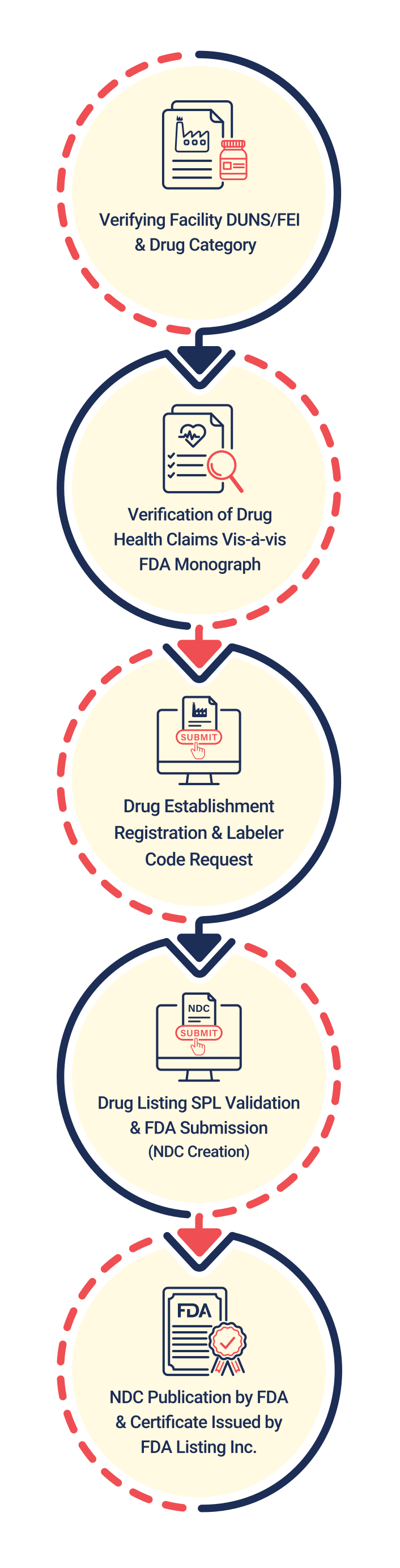
Click the button below to see the service steps in an easy-to-follow graphic format.

Who Needs a 510(k) Submission?
A 510(k) premarket notification may be required before a medical device can be commercially distributed in the United States. The applicable pathway depends on the device’s classification, FDA product code, intended use, technological characteristics, and any applicable exemption. Certain Class I and Class II devices are exempt from 510(k) requirements. Other devices require 510(k) clearance before commercial distribution. Devices subject to Premarket Approval (PMA) follow a separate premarket pathway.
The 510(k) requirement must be evaluated based on the specific device. The device name or the existence of similar products on the market does not, by itself, establish the applicable regulatory pathway.
Changes to a previously cleared device—including changes to design, materials, manufacturing processes, software, labeling, intended use, or indications for use—may also require a new 510(k) or a documented regulatory assessment. FDA establishment registration and device listing are separate requirements and do not substitute for 510(k) clearance when premarket notification is required.
What Is FDA 510(k) Clearance?
A 510(k) is a premarket notification submitted to the FDA to demonstrate that a device is substantially equivalent to a legally marketed predicate device.
The substantial-equivalence assessment generally addresses whether the subject device has the same intended use as the predicate and whether differences in technological characteristics raise different safety and effectiveness questions. Supporting information may include performance testing, labeling, risk information, and other technical documentation, as applicable.
A 510(k) results in FDA clearance, not FDA approval. Devices subject to Premarket Approval follow a separate FDA approval pathway. Predicate selection is a key component of the 510(k) strategy. The predicate should be legally marketed and appropriate for the intended use and technological characteristics of the subject device. An unsuitable predicate or inadequately supported technological differences may result in FDA questions, additional-information requests, or reconsideration of the proposed regulatory pathway.
510(k) Requirements & Submission Process
The content of a 510(k) depends on the device type, classification, product code, intended use, technological characteristics, claims, predicate device, and applicable FDA requirements.
A 510(k) submission commonly includes:
- Device name, manufacturer information, model numbers, and trade names
- Device classification, FDA product code, and applicable regulation
- Device description, operating principles, materials, specifications, photographs, and drawings
- Proposed indications for use and intended use
- Identification of the legally marketed predicate device
- Substantial-equivalence comparison between the subject device and predicate
- Proposed labeling, instructions for use, packaging, and applicable claims
- Applicable performance testing and technical documentation, including sterilization, biocompatibility, shelf life, packaging, electrical safety, electromagnetic compatibility, software, cybersecurity, usability, or clinical information, as applicable
- FDA administrative forms, certifications, declarations, and applicable user-fee documentation
Most 510(k) submissions—including Traditional, Special, and Abbreviated 510(k)s—are prepared and submitted electronically using FDA’s electronic Submission Template and Resource (eSTAR), unless an applicable exemption or waiver applies. eSTAR is submitted through the CDRH Portal and incorporates structured content and validation features to support submission preparation. FDA subsequently conducts its applicable acceptance and substantive reviews and may request additional information.
Common 510(k) Submission Process
- Device Classification and Regulatory Pathway — Evaluate the device classification, product code, applicable regulation, and appropriate premarket pathway.
- Predicate Device Assessment — Identify and evaluate legally marketed predicate devices that may support substantial equivalence.
- Technical Documentation and Gap Assessment — Review available device documentation, labeling, testing, and supporting records to identify gaps.
- 510(k) Preparation — Compile and organize the administrative, technical, and supporting information required for the submission.
- eSTAR Preparation and Submission — Complete the applicable eSTAR template, address validation issues, and submit the 510(k) through the CDRH Portal.
- FDA Review and Response Support — Support responses to FDA requests for additional information, as applicable.
- Clearance and Post-Clearance Compliance — Following clearance, address applicable establishment registration, device listing, UDI, labeling, and other post-clearance requirements.
Preparation timelines depend on device complexity, predicate availability, technical file completeness, testing requirements, and the quality of existing documentation. You must generally pay the applicable FDA user fee before the FDA accepts the 510(k) for review, unless an exemption applies.
Important 510(k) Compliance Considerations
510(k) clearance is not FDA approval. The FDA has determined a cleared device to be substantially equivalent to a legally marketed predicate. A manufacturer should not represent a 510(k)-cleared device as “FDA approved” solely because of 510(k) clearance.
Registration and listing are separate requirements. Following 510(k) clearance, the manufacturer must complete applicable FDA establishment registration and device listing requirements. The device listing should accurately reflect the cleared device and applicable premarket submission information.
Changes to a cleared device require regulatory assessment. Changes to device design, materials, manufacturing processes, software, labeling, intended use, indications for use, or other technological characteristics should be evaluated to determine whether a new 510(k) is required.
FDA user fees apply. FDA charges user fees for most 510(k) submissions. Manufacturers seeking the reduced small-business user fee should obtain an FDA Small Business Determination before paying the user fee and submitting the 510(k). Eligibility is based on FDA’s applicable small-business criteria.
What Happens After FDA 510(k) Clearance?
After FDA clearance, the manufacturer receives a 510(k) number (K number) for the cleared device. The device may then be commercially distributed in the United States, provided the manufacturer has satisfied all other applicable FDA requirements. Post-clearance requirements may include:
- FDA medical device establishment registration
- FDA device listing and applicable 510(k) information
- UDI assignment and GUDID submission, where applicable
- Compliant device labeling, instructions for use, and promotional claims
- U.S. Agent designation for foreign medical device establishments
- Ongoing regulatory assessment of changes to the device, labeling, intended use, or manufacturing process
Foreign establishments that manufacture, prepare, propagate, compound, assemble, or process medical devices for U.S. distribution generally must comply with applicable FDA establishment registration, device listing, and U.S. Agent requirements.
How Can FDA Listing Inc. Assist?
FDA Listing Inc. provides practical 510(k) consulting and submission support for medical device manufacturers seeking U.S. market access. We tailor our support to the device, intended use, available technical documentation, potential predicate devices, and applicable testing requirements.
We can assist with:
- Classification and pathway assessment — Preliminary device classification, FDA product-code research, applicable-regulation review, and 510(k) pathway assessment.
- Predicate and substantial-equivalence support — Predicate-device research, comparison support, and review of intended use, indications for use, device description, and labeling.
- Documentation and submission preparation — Technical-documentation gap assessment, organization of supporting records, review of administrative documents, and eSTAR preparation.
- FDA submission and review support — Electronic 510(k) submission support and assistance with FDA requests for additional information, where applicable.
- Post-clearance compliance services — Establishment registration, device listing, UDI/GUDID, labeling, and U.S. Agent services.
The scope, fees, and timelines for 510(k) consulting and submission support depend on the device classification, predicate strategy, technical documentation, testing requirements, and overall submission complexity.
Service Details & Fees

Drug Establishment Registration

OTC Drug Listing

Time Required

U.S. Agent

Obtaining NDC codes

OTC Label Assessment

FDA Registration Certificate
495 USD
495 USD
4-5 Days
_______ Related Services _______


Frequently Asked Questions (FAQ)
No. The applicable premarket pathway depends on the device classification, product code, intended use, and any applicable FDA exemption. Depending on the device, the applicable pathway may include 510(k), De Novo, PMA, or an exemption from premarket notification.
No. A 510(k) is a premarket notification pathway based on substantial equivalence to a legally marketed predicate device. Devices subject to Premarket Approval follow a separate FDA approval pathway.
FDA’s MDUFA performance goal is to issue a decision on 95% of 510(k) submissions within 90 FDA days. This is an FDA performance goal, not a guaranteed total calendar timeline. Actual timelines may vary based on submission completeness, device complexity, FDA review, and requests for additional information.
A predicate device is a legally marketed device used as the comparison device in a 510(k) submission. The subject device generally must have the same intended use as the predicate, and its technological differences must not raise different questions of safety and effectiveness.
No. Establishment registration and device listing are separate FDA requirements. When a device requires 510(k) clearance, you must satisfy the applicable premarket requirements before commercial distribution.
The electronic Submission Template and Resource (eSTAR) is FDA’s electronic submission template used for 510(k) and certain other medical device premarket submissions. Unless an applicable exemption or waiver applies, 510(k) submissions are prepared using eSTAR and submitted through the CDRH Portal.
Yes. Certain changes to device design, materials, manufacturing processes, software, labeling, intended use, or indications for use may require a new 510(k). Manufacturers should conduct an appropriate regulatory assessment before implementing significant changes to a cleared device.
_______ Related Services _______